
Apple Crisp
A warm dish of fall comfort

Apple Crisp
A warm dish of fall comfort
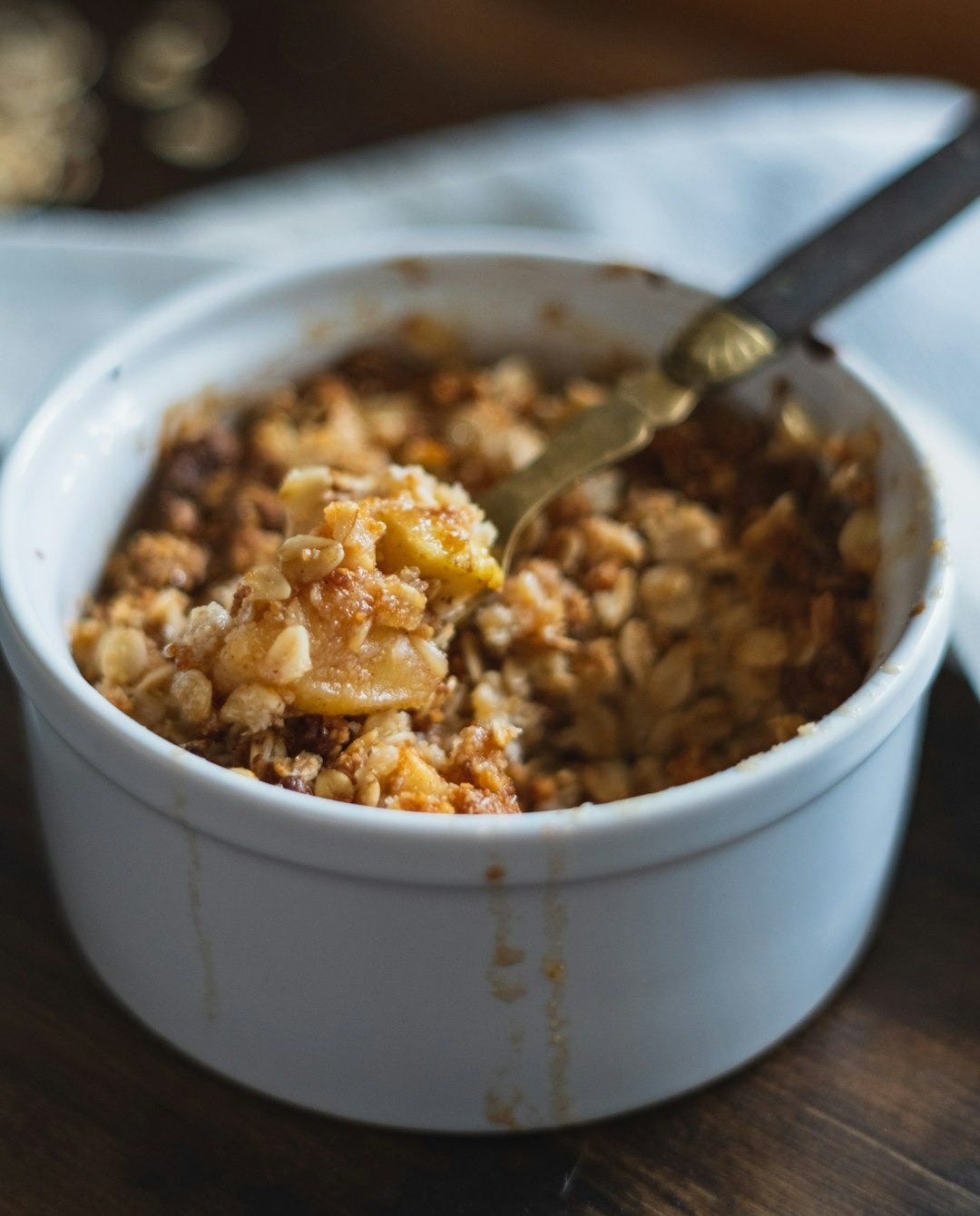
Just about every fall, our family would go apple-picking. We’d search out the few orchards that grew Russets (my favourite eating apple), and we also bagged up some Cortland and Northern Spy varieties—perfect for baking apple pies and casseroles of apple crisp. My sister and I loved our mother’s recipe for apple crisp. Honestly, I can still smell the wafts of baked cinnamon and apples as she opened the oven door. And wouldn’t you know that my sister—keeper of miscellaneous family stuff ad infinitum—reached into her cupboard the other day and brought out the very casserole dish that held the apple crisp of our youth.
Baked into the sweet/tart taste of apples and the crisp crunch of the topping is pure comfort. It must have been doubly comforting to dig into this homey dessert during wartime when Britain was smitten with the frugal apple crumble—a twist on the name that has sent food historians into a tizzy. What makes a crisp a crisp and a crumble a crumble, they muse. Some say oats give a crunch to the crumble that transforms a crumble into a crisp. Others poo-poo the idea, pointing to a 1945 recipe for Fruit Crumble published in The Colborne Express that calls for rolled oats. To further confuse the issue, a 1916 recipe for Apple Crisp in the Freeport Journal Standard requires no oats. (Is your head hurting yet?)
What we know for sure is that World War II popularized this simple dessert, whatever you might call it. In 1940, Britain began rationing butter—a key ingredient of apple crumble. German U-boats were the culprits that contributed to the issuing of ration books. Enemy ships attacked Allied convoys carrying provisions across the Atlantic, destroying millions of tons of food. Rationing ensured that a portion of whatever food remained was distributed fairly across the nation. The two-ounce weekly butter allowance would scarcely stretch to cover all household requirements. So, out went butter-crust apple pies, in came lard-laced apple crumble.
In wartime Britain, butter might have been rationed but apples were there for the plucking. The Bramley apple, an iconic variety sown in 1809 by Mary Ann Brailsford (but ironically named for Matthew Bramley in whose garden the tree later grew.) proved to be ideal for baking. Its lengthy harvest season, from August until March, also meant Bramleys were available for a good part of the year. Nowadays, we can choose from a mind-boggling variety, from classic Northern Spys, Granny Smiths and Cortlands to modern-day Jonagold, Mutsu and Honeycrisp varieties. Any one of these apples—or a combination of these—hold their shape, offer a balanced sweet-tart flavour and have enough firmness to retain their structure when heated, making them an ideal filling for crisps. The one apple that’s more fit for eating than for making apple crisp, is Canada’s iconic McIntosh. Discovered in 1811 by John McIntosh on his Dundela, Ontario farm, the apple accounts for more than 20 percent of apples produced in the province. As tasty as it might be, McIntosh apples break down when baked rather than holding their shape, making them more suitable for applesauce than apple crisp. (Oh, and also for naming an Apple Computer...)
Our mother’s recipe for the crumble topping called for oats. Unheard of back then were the convenient, quick-cooking packages of instant oats that we see on grocery store shelves today. The oats that went into her crisps were old fashioned rolled oats. As it turns out, this is the best kind to use for the topping: they hold their shape and add a crunchy texture. But just try finding rolled oats today. On a recent grocery shop, my husband found a bag of Bob’s Red Mill Rolled Oats on the very top shelf, high above a mind-boggling variety of instant oat flavours like Apple & Cinnamon, Maple & Brown Sugar, Peaches & Cream and Cinnamon & Spice, not to mention steel-cut and quick oats.
With the popularity of instant brands, it seems that old-fashioned rolled oats have gone out of fashion. And as more prepared foods become available at grocery stores, homemade apple crisp may become a thing of the past. Hmm, maybe that’s not so bad: for $4.50 I could pop a frozen package of apple crisp into the microwave and in a few minutes, I could be savouring the comforting aroma of cinnamon and apples —shopping for the right ingredients, not required.